What a Foot of Frontage on Lake Missaukee Actually Costs You
September 3, 2026
September 3, 2026
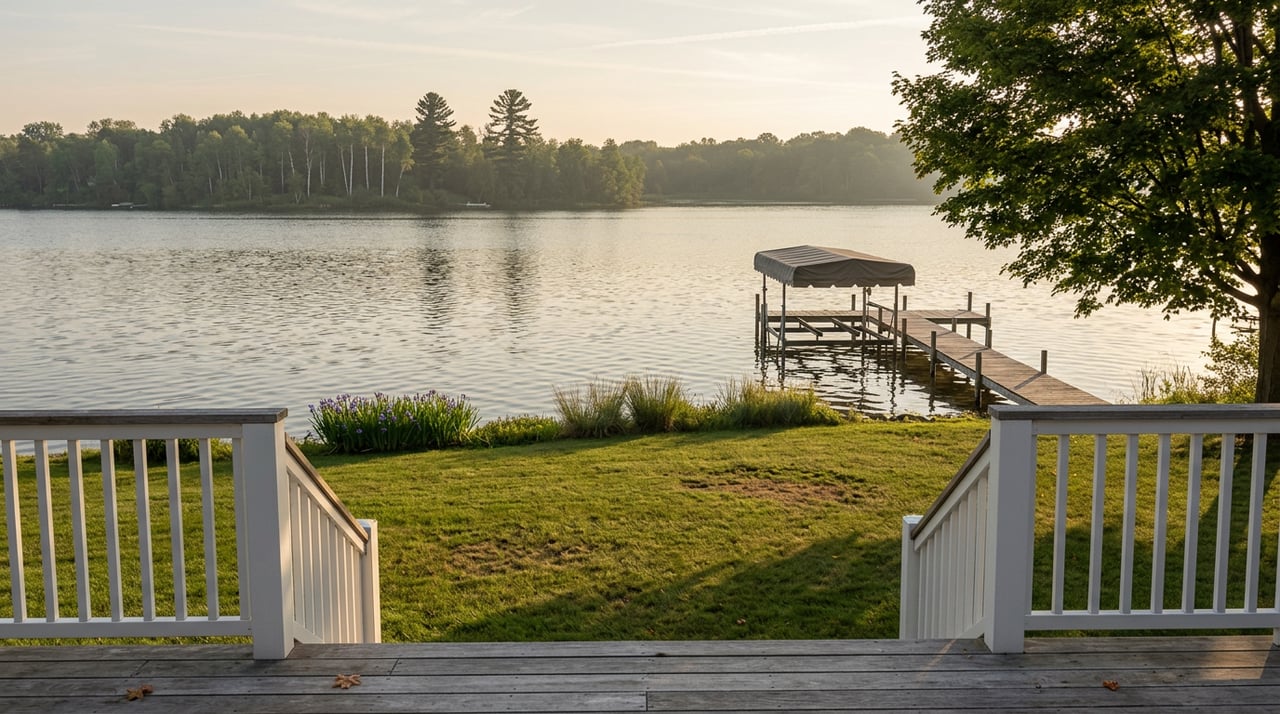
A cottage on Lake Missaukee with 70 feet of private, sandy frontage recently listed for under $500,000. A few miles away on Sapphire Lake, a cottage with 65 feet of deeded lake access, rather than owned frontage, was marketed as a reasonably priced way into the same water system. Neither listing mentions the one number that will show up on both owners' tax bills within a year of closing, and it has nothing to do with square footage, bedroom count, or even the frontage itself.
That number is the Lake Missaukee Improvement Board assessment, and almost no one shopping this market from out of state has heard of it before their first winter tax statement arrives.
Property owners around Lake Missaukee already know about the Missaukee Lake Association, a nonprofit formed in 1997 that funds water quality testing and lake advocacy. Joining costs $25 a year, and it's voluntary. Plenty of riparian owners never sign up, and nothing happens to them if they don't.
The Lake Missaukee Improvement Board is a different animal entirely. It was formed at the end of 2004, at the association's own urging, after the group learned that the Eurasian milfoil it had been treating near the county boat launch had spread into the main body of the lake. The association had been covering that localized treatment out of its own funds for years, but the problem had outgrown what a $25-a-year membership could support. The board looked at what happened on Houghton Lake, where the same weed eventually cost the community millions of dollars to bring under control, and moved to get ahead of it here.
The result is a special assessment, not a membership. It's levied against riparian parcels under Michigan's lake improvement statutes, and unlike the association dues, it isn't optional. If your parcel falls inside the assessment district, the charge rides on your property tax bill whether you ever attend a board meeting or not.
This is the part that catches buyers off guard, and it's worth understanding before you fall for a listing that advertises "deeded lake access" as a budget-friendly alternative to true frontage.
Under Michigan's lake improvement laws, assessment districts are typically built to include every lakefront parcel plus any back lots that carry deeded or dedicated access to the water. The charge itself is meant to track the benefit each parcel receives, and frontage footage is one of the standard factors boards use to apportion the cost. A parcel with more shoreline generally carries a larger share of the assessment than a parcel with less, and a back lot with deeded access can be swept into the same district as a home sitting directly on the water, even though it never touches the shoreline.
So that Sapphire Lake cottage with 65 feet of deeded access isn't necessarily sitting outside the cost structure just because it isn't technically waterfront. The question a buyer should be asking isn't just "how much frontage does this have." It's "does this parcel sit inside the assessment district at all, and if so, what's my share."
Lake Township holds four named lakes, and treating them as interchangeable is where a lot of out-of-area buyers go wrong.
| Lake | Approximate size | Public access | Character |
|---|---|---|---|
| Lake Missaukee | 1,880 acres | Yes, DNR-maintained launch at Missaukee County Park | The county's largest lake, all-sports, borders Lake City directly |
| Sapphire Lake | Roughly 250 to 265 acres | Yes | Smaller, mixed year-round and seasonal homes, some rare wide-frontage lots |
| Crooked Lake | More than 400 acres | Yes, county park with launch and hiking trails | Mid-sized, quieter, anchors Crooked Lake County Park |
| Round Lake | Not publicly reported | No, privately owned | No public access site at all |
Three of the four lakes fall under the same public governance structure that produced the LMIB. Round Lake sits entirely outside that picture, privately owned with no public launch. A buyer comparing "lakefront in Lake Township" without asking which of these four lakes a listing actually sits on is comparing four different regulatory and cost environments as if they were one.
Once you understand that the assessment is frontage-weighted, it's tempting to assume more feet always means more cost and more value in equal measure. The listings themselves argue against that.
That 178 feet of private waterfront on Sapphire Lake was marketed as one of the few parcels on the lake with that much frontage, a genuine rarity. Meanwhile a Lake Missaukee cottage with 70 feet, built at 600 finished square feet, listed for well under $500,000. Over on Dyer Lake, a quiet 125-acre private all-sports lake nearby in the same county, one remodeled cottage carried 89 feet of frontage while another comparable property carried just 43. None of these numbers move in lockstep with price, because bottom type, depth, cove versus open water, and how much of the shoreline is actually usable for swimming or docking matter as much as the raw footage.
The practical read for a buyer: frontage tells you your likely share of a mandatory cost, not your likely enjoyment of the water or the eventual resale value. Those are three separate questions, and a listing sheet answers none of them directly.
Missaukee County has been investing in the public side of Lake Missaukee even as the assessment funds the ecological side. The county flagged a boat launch replacement at Missaukee Lake Park for fall 2025, upgrading the lagoon access that also serves the park's 80 rental boat slips. Campsite and slip reservations for the 2027 season are set to open October 5, 2026, which tells you the county expects steady demand well past this season.
None of that capital spending comes out of the LMIB assessment, which is earmarked specifically for milfoil treatment. But it's a useful reminder that Lake Missaukee carries two separate funding tracks working at the same time, one through county parks and recreation, and one through the riparian-funded lake board. A buyer who only asks about one is missing half the picture.
If you're looking at anything on Lake Missaukee, Sapphire Lake, or Crooked Lake, ask two questions before you get attached to a frontage number:
First, is this parcel inside the LMIB special assessment district, and what has the seller actually paid in the most recent tax cycle. That figure should appear on the property's tax history, not just the listing sheet.
Second, if the listing advertises deeded or shared lake access rather than true frontage, confirm in writing whether that access still places the parcel inside the assessment district. The distinction between owning shoreline and owning a right to reach shoreline matters less to the assessment than most buyers assume.
The list price on any of these homes is only a starting point for a conversation, not the whole conversation. The frontage number next to it is a second starting point. Neither one tells you what you'll actually owe once the tax bill arrives.
Does every property near Lake Missaukee pay the LMIB assessment? No. The assessment applies to parcels inside the district the board established, generally lakefront properties and back lots with deeded or dedicated access. A property near the lake but outside that district would not carry the charge.
Is the $25 Missaukee Lake Association membership the same thing as the assessment? No, and this is the most common confusion. The association membership is voluntary and funds advocacy and water testing. The improvement board assessment is mandatory for parcels in its district and funds milfoil treatment specifically.
Does Sapphire Lake or Crooked Lake have its own separate lake board? The Lake Missaukee Improvement Board's formation was tied specifically to milfoil spreading in Lake Missaukee. Buyers on Sapphire or Crooked should ask directly whether either lake has its own board or assessment history, since the three lakes share a township but not necessarily a governance structure.
If you're weighing a lake property in Missaukee County and want someone who can walk the tax history and the frontage numbers with you before you write an offer, Daniella Bell Group has spent 25 years reading exactly this kind of fine print for buyers finding their way to the water. Find Your Beautiful Life starts with knowing what you're actually buying.
Stay up to date on the latest real estate trends.